
SYKES SNIPPETS
All with kind permission of Cumbria Archives, Whitehaven. RAVENGLASS TRAIN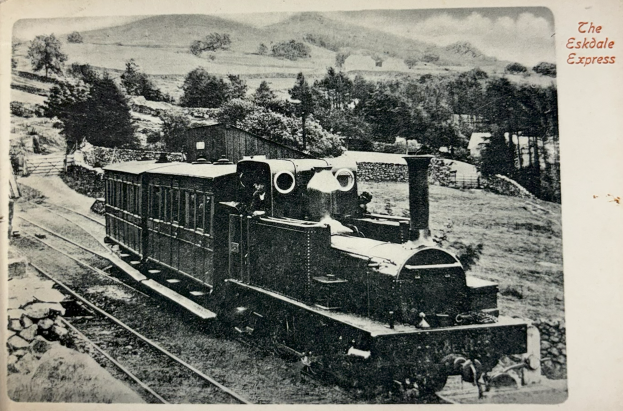
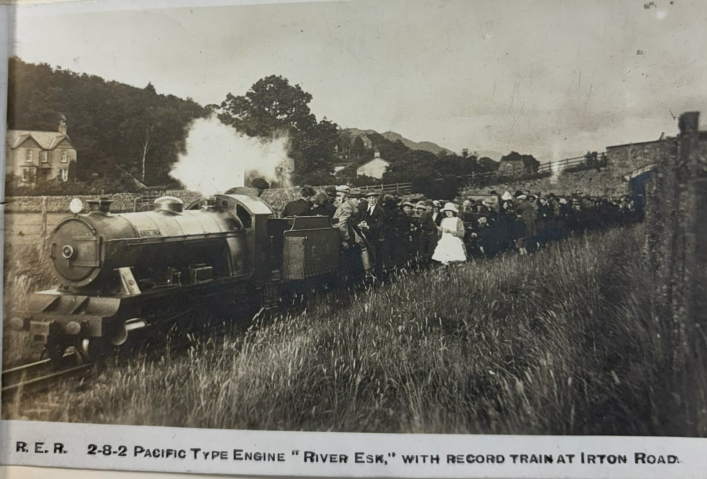
The train Ravenglass to Boot under the old management often came to a standstill at the incline near Boot. And the good guard would address the passengers. First class can you keep your seats. Second class can you get out and walk. Third class can you push behind.
The train in the morning was often held back to enable Dr. C. to join it. On one occasion he was so late that the train started without him. At Muncaster Mill the guard was much surprised to see the Dr. looking out of a window. "Why how did you come there?" He asked. "Oh," said the doctor, "I saw the train just going round the corner at Ravenglass and I ran after it and climbed in." It often happened that a sheep or cow would be on the line and the engine driver would pelt the animal with coal to drive it from between the rails. One station was the half of an old sea boat and occasionally I have seen the train stop there to put down a bottle of medicine - on one occasion a wire spring mattress was left till the farmer from some distance across the fields had time to fetch it. The saloon carriage was the delight of the visitors - an old cattle truck with benches round it. The line was originally constructed for the iron miners near Gill Force above the Church. For many years after the miners were given up, a partly filled truck remained in a siding near Kirk House. The miners are said to have come from Wales or Cornwall and in the early days there was great jealousy among the young men of the Dale when their sweet hearts were alienated from them by the new ways of the "foreigners." One man was specially warned that his attention to a certain girl must cease or ill would follow. No notice was taken. SALT PANS This is what our old friend Rev. Sykes says about saltpans. Three things seem to have been considered essential for the site of a saltworks - a plentiful supply of peat - a stream of fresh water - a ready access to the sea shore. The manufacture of salt commenced on the shore in a series of shallow tanks divided by clay walls. Into the first probably the tide flowed and when it receded the sand was scraped up and placed in a higher tank and sea water added perhaps just by the highest tide - this might be repeated in a third tank in which the water partly by percolation and the aid of sun and wind, gradually evaporated leaving a thick coating of salt and sand sludge. The second stage necessitated conveyance of this rough deposit to the works which in some cases, as for example Kirksanton might be a considerable distance from the shore; hence in the charters provision was made for draught oxen. At the works the sludge was taken to the sand pit - hence a reference in the Rutan part? Charters to the sandclose - where it was placed in rough wooden troughs in part of which the bottom was pierced with fine holes fresh water was then placed in the toughs and this carried the salt to the brine pits - deep store tanks in which by constant addition and evaporation the solution becomes very strongly impregnated with salt. The final stage was in the boiling house and whether the monks used lead pans as in later days was customary (C&W Trans xiv p 289) or more like the Roman baths a tiled vat with heating chambers beneath there is nothing in the charters to show. After boiling for several hours the salt began to form when it was raked out of the vat and put into baskets to drain and dry in the compartment near the boiling house through which the flues passed. Most of the boiling seems to have been done in the summer months from Easter to S Barthos. In the xvith century it is stated (C&W Trans xiv 288) that "the whole coastline of Holm Cultram was studded with saltpans" and it may be that the Millom works continued till about that time but (C&W Trans xxi 76) by 1566 the trade was evidently on the decline because small coasting boats which took cod and herrings to Liverpool and Chester returned with cargoes of salt. Powse Foot near Rottington (site of one of the Millom works) is one of the posts mentioned. No estimate can be found of the quantity of salt manufactured in Millom but it was evidently considered for in the taxation of 1292 (Elip 634) it is shown that after deduction of working expenses the value of the salt works at Kirksanton was 3s 4d or nearly 1/10 the value of the sheep farm at Meles and 1/10 of that of the cattle farm at Brotherilkel. There were three salt works in Millom constructed by monks. I Circa 1160-70 William de Boivil of Kirksanton granted to Furness Abbey a pasturage called Meles near the shore. He also gave them the right to dig as much peat as they required in what is now called The Haws and to stack and dry it and carry it through the manor lands. There was also at Kirksanton close to Helpa Bridge then called Layr wath (wath = a ford) a small ancient salt works which was at one time in the hands of Nigel f. Reginald. The monks c.1213-20 obtained from William f Henry of Millom a grant of the site with all that belonged to it in foreshore moss rooms and pasture. Also he gave them extra land 4 acres next Layrwath and commonage for 8 oxen and 4 horses. The site approximately must be that now called Elphole and the 4 acres Micklethwaite both near the level crossing of the Furness Railway by the Standing Stones. This works was much increased by permission of Sir John Hodilston c1270-80 who gave them leave to erect another pan and to add 2 acres to their foreshore and as much peat as was necessary for this addition. II The example of Furness was quickly followed by St Bees. The next most important site was near the great peatmoss below Arnaby; and c1230-40 St Bees obtained from Adam f Henry a grant to construct a new place where Slepul also called Helepool and now Shawpool enters the Duddon. The grant included pasturages for 8 oxen 6 cost and 20 sheep and all necessary ... from the great peatmoss. The details show the provision made for haulage and the shore tanks may have been at Saltcoats nearly half a mile away from the mouth of the gutter which was unsuitable for the outdoor tank. The land marks have been obliterated but the sites of the works was within the vill of Millom, the gutter being the boundary. The description of the land which the monks had leave to enclose by a traverse to exclude Barker-Hals. And there by a straight line to Slepul i.e. that branch of which runs from the direction of Roanland and so down the Slepul makes it fairly certain that the works were within or close to the field now called Soaper wash. In 1276-8 Sir John de Hodleston confirmed the grant and added extra pasture i.e. the field formerly held by Thomas vicar of Millom. III The third saltern was just outside the Millum Park. If Salt House preserves the site of the boiling house this was within the Park enclosure. It would seem possible that before the works were granted to the monks of Calder it might have been worked for the advantage of themselves and their dependants by the Lords of Millom. At what date the Abbey of Calder obtained the original grant is not clear but Sir John de Hodleston in granting additional privileges refers to charters of his predecessor. If the grant of John Fleming (St B. xlvi) is rightly found with the site as in my notes (C & W xxvi p 143) the monks must have been in possession as early as c1240. The grant of Sir John refers to the sand enclosure i.e. where the rough sludge was washed and the salt passed into the brine pits - this sand enclosure is a known place. Also he speaks of an extension for conveying this rough salt from the shore but though horses cows and sheep are spoken of the draught oxen are not mentioned, the inference being that the tanks on the shore were so near the brine pits that the haulage was comparatively light. One other matter is included in the grant - the monks had permission to divert the course of the stream called Rutland pool - the name is now Rottington. This diversion seems to imply either (1) that they constructed a leet or channel from the stream later called the Wyre out of the field below the present Day School to supply fresh water for washing the sand at their sand enclosure, or (2) to alter the course of the pool upon the sands to prevent it flooding their shore tank. If the latter seems more probable the site of the shore tanks must have been in the angle where the Rutland pool joins the Salthouse pool. Unfortunately the railway sidings to the iron works have obliterated most of the traces, but some rough banks not far from the Millom station were pointed out to me as having once been old pits before the construction of the railway. For the original see Sykes Project p80-86.